Dive into our monthy AI update to find out what’s happening in the industry and what it means for you.

Ahead of Times – Issue 11
Paula Hijosa
AI & Performance Lead

AIClientsIndustry
In this article
anchor
AI transparency moves into the workflow: labels, disclosure and what comes next
AI labelling is quickly becoming part of the day-to-day campaign workflow. In the past few weeks alone, the European Commission published official guidance on Article 50 of the EU AI Act and introduced a set of free, optional AI disclosure icons, while Google began rolling out new AI disclosure controls across its advertising platforms. The guidance also provides much-needed clarity on what actually qualifies as AI-generated or AI-modified content. One example likely to resonate with marketers is that an authentic photograph of an empty apartment that is furnished using AI should carry an AI modified label, even though the original image itself is real.
At the same time, Meta, TikTok, YouTube and Google are building new ways to detect, label and surface AI-generated content. Meta’s newly launched Content Seal, AI likeness detection tools from TikTok and YouTube, and the European Commission’s new disclosure icons all point in the same direction: AI transparency is moving from policy into platform infrastructure. Advertisers may get more help with labelling, but responsibility for disclosure still sits with the deployer, not the platform.
Why it matters
- AI disclosure is becoming a practical campaign step, not just a compliance exercise.
- Platform labels are not a compliance solution. Google, Meta, TikTok and YouTube may detect, flag or label content automatically, but responsibility for disclosure still sits with the deployer or advertiser.
- Brands need visibility of where AI has been used across creative production, especially for realistic AI-generated people, voices and deepfakes reaching EU audiences.
- The EU AI Act only applies where AI outputs reach EU audiences, but even UK marketers outside its scope should still pay attention. While the UK regulates AI through existing frameworks rather than a dedicated AI Act, transparency, governance and understanding where AI has been used are becoming increasingly important parts of campaign delivery.
Example of an AI-generated property image using an EU disclosure label:

anchor
Google Zero: Google keeps the answers, but who gets the value?
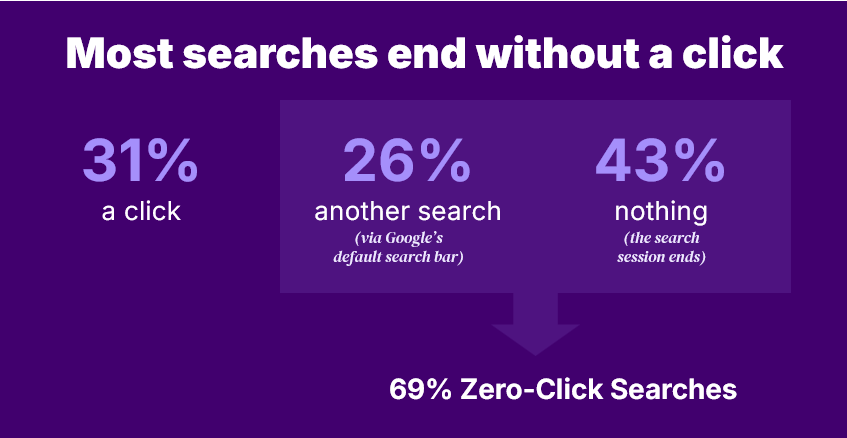
For years, the relationship between Google and publishers was straightforward: publishers provided content, and Google sent traffic back. As AI Overviews and AI Mode increasingly answer questions directly on the search results page, that value exchange is coming under pressure. New research from SparkToro found that 69% of Google searches in the UK now end without a click, while Google’s own leadership says AI is helping Google to drive search growth and revenue.
The most telling development came from Reddit. In July, reports emerged that the platform is reassessing its reported $60 million-a-year deal with Google as it nears renewal. The concern is simple: if AI-generated answers increasingly keep users within Google’s ecosystem, is the return worth the content being supplied?
For publishers, the stakes are particularly high because their business models depend on audiences, advertising revenue and subscriptions. Commercial brands may be less exposed. Even if traffic falls, AI search, recommendations and emerging agentic experiences can still create value if they drive product discovery and sales. As Google Zero accelerates, the real question is shifting from clicks to value exchange: who benefits when AI keeps the audience but relies on everyone else’s content?
Why it matters
- Zero-click search is no longer just a user behaviour trend, it is starting to reshape the relationship between Google and the publishers that supply much of the web’s information.
- For publishers, this is ultimately a revenue challenge. News organisations and media owners rely on audiences, advertising and subscriptions. If fewer users visit their sites, it affects not just traffic, but the economics of creating original content and journalism.
- For brands, the picture is more nuanced. Traffic may decline, but AI-driven search, shopping assistants and agentic commerce can still create value if they help users discover, compare and buy products. The challenge shifts from winning clicks to being present, trusted and machine-readable wherever AI is making recommendations.
Source: UK data. SparkToro via SimilarWeb (January – April 2026):
anchor
ChatGPT Work: AI Becomes a Co-worker
OpenAI launched ChatGPT Work in July, its latest attempt to turn ChatGPT into more than just a chatbot. The new product can connect to files, apps and business tools, carry out multi-step tasks, create reports, presentations and spreadsheets, and keep projects moving in the background. It joins Claude Cowork and Microsoft’s Copilot Cowork in a growing race to build AI tools that do more than generate content, they help complete meaningful work.
What’s interesting is that this isn’t just a workplace story. The same tools being used to analyse data, build presentations and automate workflows are also helping people research holidays, compare products, plan purchases and make decisions. As these agents become part of everyday life, brands need to think about more than search visibility. Increasingly, they need to ensure their products, content and expertise can be found, understood and recommended by the AI tools people use to get things done.
Why it matters
- As AI co-workers become more capable, people are increasingly setting the objective and letting the AI handle much of the research, analysis and execution. Whether that is a business task or a personal project, more decisions and actions are happening inside AI tools rather than traditional websites, search engines or apps.
- This is particularly relevant for B2B marketers. The same tools that help employees prepare meetings, research competitors and create presentations can also help them evaluate suppliers and products. Part of the buying journey may increasingly happen inside ChatGPT, Copilot or Claude co-workers before a prospect ever reaches a website. For brands, it’s a reminder to get product data AI-ready now. OpenAI has already published specifications for submitting product feeds, giving an early glimpse of where AI-led buying journeys could be heading
- The biggest immediate benefit is productivity. Tasks like meeting preparation, research, reporting, weekly briefings and presentations can increasingly be delegated to AI.
anchor
Muse Image & Muse Video: Meta takes AI creativity in‑house
Meta launched Muse Image and previewed Muse Video in July, its first in-house image and video generation models from Meta Superintelligence Labs. Muse Image is available through Meta AI, Instagram and WhatsApp in the US, while Muse Video remains in preview.
Early results have been strong. Both Muse Image and Muse Video rank among the leading models on Arena, a benchmark where people compare AI-generated content side by side.
The launch is already attracting criticism around consent and privacy. Meta has been criticised for allowing users to generate images using references from public Instagram content, raising concerns that many people may not realise their public photos can be used in this way. Users who do not want their content used for AI-generated images may want to review their privacy and AI settings.
Why it matters
- Questions about control, consent and privacy are only going to grow. As these tools become more common, the conversation is moving from what AI can create to who gets to decide how personal images and content are used.
- Meta is bringing AI creative tools directly into its advertising ecosystem. Muse Image will power new creative generation capabilities within Advantage+, helping advertisers create more creative variations and ad assets.
- Muse also claims to maintain consistency across multiple rounds of editing and refinement. If it delivers, that could make AI creative workflows much more practical, reducing the image drift and quality loss that often happens when iterating on a concept.
anchor
ChatGPT Ads: early learnings from a new channel
A few weeks into testing, ChatGPT Ads is starting to show both the potential and the limitations of advertising inside an LLM. The platform remains one of the simplest advertising products on the market, with limited targeting, reporting and forecasting tools. That said, we’re already seeing regular updates and improvements as OpenAI develops the beta. While it’s still early days, the pace of change suggests the platform could look very different in the coming months.
Measurement remains the biggest challenge. We can see impressions, clicks, spend and conversions, but there is still limited visibility into why ads were served, which conversation themes drove performance or how much inventory is available before a campaign launches.
Initial findings:
- The opportunity is there, but measurement is limited. We can’t see the prompts, conversations or audience signals behind them. When performance changes, there is very little insight into why.
- In our testing, we haven’t seen a conversion yet and the results are mixed. Compared with Google Ads, ChatGPT Ads delivered nearly 3x more impressions and slightly longer engagement time (+14s), but fewer clicks, resulting in lower CTRs overall.
- Competition is still relatively low as ChatGPT Ads has only recently launched in the UK. That creates an opportunity to test before inventory becomes more competitive and costs increase (something It has been reported in US, with CPC increasing overtime, which is something very expectable though)
- At the end of July, there were 3,026 advertisers in the UK (vs 11,901 in US). Education, Technology and Telecom were the industries with the highest ad visibility, with ads appearing in around 67% of monitored prompts (source: Adthena)
- The platform regularly recommends bid increases to stay competitive. In our testing, increasing bids has generally increased CPCs and CPMs and resulted in no more clicks or impressions.
- With limited targeting controls available, success appears to depend heavily on copy. Ads built around customer needs, pain points and decision-making moments seem better suited to the conversational environment than product-led messaging.
- There were a few unexplained billing and landing page issues that temporarily stopped my ads but were sorted quickly. OpenAI support has been good with queries initially handled by AI but quickly escalated to a human who follows up and works through the issue until it is resolved.
As a result, many brands are treating ChatGPT Ads as an innovation budget rather than a core performance channel.
Read our latest news and thoughts.

AI Trends
5 AI predictions that will shape 2026
Paula Hijosa
AI & Performance Lead

Ahead of Times – Issue 10
Dive into our monthy AI update to find out what's happening in the industry and what it means for you.
Paula Hijosa
AI & Performance Lead

AI and CX: opportunity vs risk
The question isn’t whether we should use AI in CX, but it’s about differentiating between where it adds value to our business outcomes, and where it jeopardises our credibility.
Ariel Chiaffarelli
Media Executive


AI and Copyright: Navigating the “Wild West”
Last week, Space & Time’s Heather Connearn joined a panel of industry experts (Mike Octigan, Sukanya Wadhwa, Stephen...
Emma King
Marketing Manager