Dive into our monthy AI update to find out what’s happening in the industry and what it means for you.

Ahead of Times – Issue 12
Paula Hijosa
AI & Performance Lead

AIClientsIndustry
In this article
- Reddit's citation drop: a reminder that AI visibility can change fast
- Microsoft Ads - AI Max rolled out globally (launched in beta in May)
- ChatGPT Ads keeps growing: global expansion, $1bn milestone and new platform updates
- Claude introduces watermarking for AI-generated text
- ChatGPT Atlas is gone, but AI-powered browsing is just getting started
- A big week for AI: new models from every major player, and GPT-6 Astra's 'AGI era' claims
anchor
Reddit’s citation drop: a reminder that AI visibility can change fast
One of the stories generating the most buzz in AI search over the past few weeks was an unexpected change in AI citations and the sources that LLMs rely on to generate answers. While Reddit, YouTube, Wikipedia, LinkedIn, review platforms (G2, Yelp, Trustpilot etc) and news publishers consistently appear among the most-cited sources, several reports pointed to a surprise at the top of the list.
Around 14 August, companies including Petra Labs reported a sharp drop in Reddit citations within ChatGPT, with visibility falling by around 80% almost overnight. Follow-up analysis suggested the decline wasn’t limited to Reddit, with other social platforms also seeing fewer citations, although Reddit appeared to be the hardest hit. Interestingly, this seems to be specific to ChatGPT, and it’s still unclear what’s driving the change.
Why it matters:
- Whether this proves to be a short-term fluctuation or the result of a broader update, it highlights how quickly AI visibility can change.
- The analysis found that some citation share moved to company-owned websites, showing that authoritative content can earn AI visibility even when a business doesn’t sell the product directly
- Citation patterns vary significantly by industry, topic, user intent and geography, so it’s important to understand what drives visibility in your own category.
- Your website remains the foundation for expertise, evidence and credibility, while YouTube is becoming one of the most prominent citation sources across AI platforms. Together, strong website content and video content can significantly improve AI visibility.
Alex Moran, Head of Organic Growth at Space & Time:
“This change is a symbol to the power a limited number of platforms have; this is not new in the industry though previously Google had a strong control alone. The lesson is that looking for quick wins is not a sustainable strategy and instead focussing on long term sustainable growth across channels and platforms that suit you as a brand. If you have seen the previous high citations numbers for Reddit and invested significantly, but disingenuously and without a clear strategy then you are likely to be questioning that investment now. However, taking steps towards establishing an accurate presence across third-party platforms, including non-social platforms, as a whole is going to be very beneficial to brands within the new state of search.”
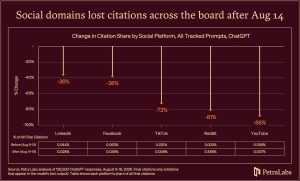
Source: Petra Labs
anchor
Microsoft Ads – AI Max rolled out globally (launched in beta in May)
Following its pilot launch in May, Microsoft expanded AI Max for Search at the end of August, making the feature more widely available to advertisers. Similar to Google’s version, AI Max uses AI to understand intent rather than just keywords, helping advertisers appear for more relevant searches, including longer and more conversational queries.
AI Max isn’t a new campaign type, but a set of AI-powered features that can be activated separately or together. These include expanded query matching, asset personalisation and smarter final URL expansion. Microsoft says the three capabilities work best when used together, as the platform can connect the search query, generated creative and landing page into a single intent-driven journey.
Are Google and Microsoft AI Max the same? Pretty much. Both products are built around the same foundations: using AI to expand reach, personalise creative and better match users with the most relevant landing page.
Why it matters
- This is another example of how AI and automation are being embedded into media platforms to improve performance. Search campaigns are increasingly gaining an AI-powered optimisation layer.
- As with any new feature, it’s worth setting aside some test-and-learn budget to see what works for your business. Microsoft says early tests showed at least an 8% uplift in conversions when AI Max was enabled.
- Traditional Search is becoming less about matching keywords and more about understanding intent. AI Max is another step in that direction.
anchor
ChatGPT Ads keeps growing: global expansion, $1bn milestone and new platform updates
ChatGPT Ads continues to generate plenty of news, with the past week bringing updates on market expansion, new platform capabilities and a major revenue milestone. Given how quickly the platform is evolving, it’s unlikely to be the last time it features in Ahead of Times.
- ChatGPT Ads has expanded to more than 40 countries, including Europe, India, the Middle East, North Africa and Brazil.
- OpenAI’s advertising business reportedly reached a $1 billion annualised revenue run rate in less than 200 days. For context, Google and Meta are each bringing in around $20-22 billion in ad revenue every month. ChatGPT Ads is still small by comparison, but that’s a pretty impressive start for a platform that’s only been running ads for a few months.
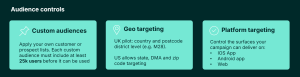
- New platform updates include one-day view-through conversion reporting, which measures conversions that happen within a day of seeing an ad when no ad click is credited for that conversion, and targeting by platform, allowing advertisers to target users on iOS, Android or Web.
Why it matters:
- More and more brands are testing ChatGPT Ads because it’s where people are increasingly going to learn, research and explore options. The opportunity is to influence decisions while they’re still taking shape, rather than waiting until someone has already narrowed down their choices.
- ChatGPT captures context rather than keywords, it has access to much greater breadth and depth of conversation, with users naturally sharing their needs, preferences and intent. This creates new opportunities for brands to appear in relevant moments. The customer journey hasn’t changed, but more of it is now happening within the same environment like ChatGPT.
- That said, performance isn’t yet at the level of more established platforms. Measurement still needs to improve, advertisers need greater visibility into the queries driving results, and the platform continues to have bugs and limitations. It’s still very much a beta product, but one that’s evolving quickly and worth watching.
anchor
Claude introduces watermarking for AI-generated text
In Ahead of Times 11, we touched on the EU AI Act’s transparency obligations under Article 50, which came into force on 2 August, and the labelling of AI-generated images. In short: AI-generated content needs to be disclosed somehow, including text in certain cases. Text is in scope when AI-generated content is published to inform the public on matters of public interest and hasn’t had human review or editorial control. Think news, political or public affairs content.
The EU AI Act applies to deployers (brands, agencies, individuals), but the heavier lifting sits with providers (e.g. the model builders like Anthropic, Google, Meta and OpenAI). And we’re now seeing that play out: Anthropic has introduced watermarking for Claude’s outputs to comply with the Act’s transparency requirements. Text gets an invisible watermark (based on Google DeepMind’s SynthID-Text approach) that travels with the text when copied and pasted.
Why it matters:
- The EU AI Act only applies where AI outputs reach EU audiences, but Anthropic is applying the watermark globally, as it doesn’t yet have a way to scope it by region. If you’re a UK marketer using Claude, your outputs carry the watermark, you just won’t notice, as the mark is invisible and doesn’t change how the text reads.
- It’s a reminder that Article 50 on AI disclosure isn’t only about synthetic images, videos or chatbots; it also covers certain types of AI-generated text.
- Transparency requirements are now live, and major AI companies are rolling out features to comply. Anthropic is one of around 190 signatories to the EU’s Code of Practice on Transparency, so expect similar moves from others.
- For marketers, the practical impact remains limited. AI-generated ad copy, product descriptions and other marketing content generally sit outside the text disclosure requirements, particularly where human review and editorial responsibility exist.
- As for who can check for it: very few, for now. Anthropic’s detection API is limited to organisations with a legal reason to verify content under the Act: regulators, law enforcement, media and fact-checkers, researchers, EU civil society groups, and enterprises with their own compliance obligations. Everyone else can register interest, with access expanding over time.
anchor
ChatGPT Atlas is gone, but AI-powered browsing is just getting started
Remember AI browsers? One of the most talked-about AI trends from the last year was the idea that your browser would become your AI assistant. Instead of searching, opening tabs, filling forms and comparing options yourself, you could simply tell the browser what you wanted to achieve and let it do the work. That vision hasn’t disappeared, but the products are changing quickly.
In August, OpenAI has retired ChatGPT Atlas, its standalone AI browser, and is instead bringing those capabilities directly into ChatGPT and Codex. Features such as navigating websites, multi-tab workflows, downloads and account logins are being folded into existing products rather than living in a separate browser.
This follows Google’s shutdown of Project Mariner a few months ago, its experimental AI web agent, with much of the technology finding its way into other Google products (like to the Auto Browse agent on Chrome). Meanwhile, Perplexity’s Comet remains one of the few major standalone AI browser plays. The trend itself is still very much alive, but increasingly through products people already use rather than dedicated AI browsers.
Why it matters:
- AI is moving at a pace where products can go from being highly hyped to retired or repositioned within months and the real opportunity is often the capability, not the product itself (a recent example being the shutdown of Sora, OpenAI’s video app, just 6 months after launch)
- AI browsers may come and go, but AI-powered browsing is here to stay. As these capabilities become embedded into ChatGPT, Chrome and other mainstream tools, the principles for brands remain the same: organisations still need structured, high-quality, machine-readable content that AI systems can easily find, understand and use.
- With new AI products launching constantly, businesses should focus on long-term trends rather than building around a single platform. A platform-agnostic approach is likely to be more resilient over time.
anchor
A big week for AI: new models from every major player, and GPT-6 Astra’s ‘AGI era’ claims
September opened with a wave of releases: Anthropic’s Claude Fable 5.1, Google’s Gemini 3.8 Flash, Meta’s Muse Spark 1.3 and OpenAI’s GPT-6 Astra. Four major AI labs, four new models, one week. The common thread? Models designed less to answer questions and more to complete tasks.
The most hyped of the four is GPT-6 Astra, released on 3 September. Its headline capability is computer use, allowing it to work across software to create spreadsheets, build websites and carry out research with less step-by-step direction, alongside improvements in reasoning and coding.
Much of the conversation is about whether Astra reaches AGI (Artificial General Intelligence). Broadly, that means AI able to learn and tackle a wide range of tasks at a human level. OpenAI has suggested Astra could mark the start of the AGI era, but that remains unproven. ARC Prize, the foundation behind the ARC-AGI reasoning tests, calls it a significant advance but explicitly says its results do not prove AGI.
Why it matters:
- This wave of releases gives marketers more models to test for research, data analysis and content creation. The opportunity is less manual work across the process, not just faster copywriting. Focus on practical results and time saved, rather than the AGI label.
- Compare how well each model completes the job. Test the new releases on the same task: do they finish it correctly, how often do you need to step in, and how much time and money does it take? One model might be better at uploading, formatting and scheduling approved website content, while another could be better at finding and fixing broken links across the site. Choose according to the task, not the launch hype.

Image source: ChatGPT
Read our latest news and thoughts.

AI Adoption in the UK: What Gen Z, Millennials, Gen X and Boomers Are Really Using AI For
63% of all UK adults who use the internet have used AI ‘in the last month’, according to GWI’s latest quarterly survey (Q4 2025).
Fiona Booth
Research Director


Ahead of Times – Issue 11
Dive into our monthy AI update to find out what's happening in the industry and what it means for you.
Paula Hijosa
AI & Performance Lead
Google Ads AI Max for Search Campaigns: What You Need to Know
Discover how Google’s AI Max for Search helps boost conversions, improve cost-efficiency, and reach high-performing new queries—making campaign optimisation easier and more effective.
Paula Hijosa
AI & Performance Lead
5 ways AI is already saving time in campaign management
Discover how AI is revolutionising campaign management with five practical ways it saves time and enhances performance. From media planning and budget optimisation to creative generation and audience targeting, learn how AI tools are making a significant impact.
Paula Hijosa
AI & Performance Lead