Dive into our monthly AI update to find out what’s happening in the industry and what it means for you.

Ahead of Times – Issue 13
Paula Hijosa
AI & Performance Lead

AIIndustryMediaTechnology
In this article
- Google is making links more prominent in AI Search
- ChatGPT Ads gets more visual and conversational with new formats
- Always-on AI workers that keep working when you’re not there
- The UK is looking at clearer rules for AI labelling
- When AI copies get more attention than the original
- AI leaders want to slow down AI development
anchor
Google is making links more prominent in AI Search
Google is changing how links appear across AI Overviews and AI Mode, adding more inline links and placing them higher up within AI-generated answers. It’s also testing prominent links to official sources at the top of some responses, expanding news carousels and making related articles more visual with images and more clickable formats.
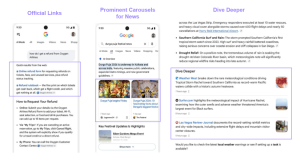
Zero-click searches have been one of the biggest concerns around AI Search, particularly for publishers. Google now seems to be finding a middle ground: giving users answers directly through AI, while keeping links and the wider web much more present in the experience. However, that doesn’t guarantee more traffic, but it creates more opportunities for users to click through.
Why it matters:
- With links appearing more often and higher up in AI answers, brands have more opportunities to turn AI visibility into actual website visits.
- AI may already give users much of the answer, so getting cited isn’t enough. Content still needs to give people a reason to click, whether that’s more detail, a product, a tool or the next step.
- Making the original sources more prominent also gives users an easier way to check the information for themselves, helping build trust in the AI answer.
anchor
ChatGPT Ads gets more visual and conversational with new formats
There have been a few new updates to the ChatGPT Ads platform. It’s still in beta and has plenty of room to mature, but OpenAI continues to evolve the advertising experience. Two of the latest formats being tested are Sponsored Agents and new visual ads. Neither is available in the UK yet, but they give us a good indication of where the platform is heading.
The first is Sponsored Agents, which introduce a much more conversational advertising experience. After clicking an ad, rather than going straight to a landing page, users can choose to open a separate, clearly labelled chat with the business’s AI agent. From there, they can ask questions, explain what they’re looking for and explore whether a product or service is right for them, before choosing whether to visit the brand’s website. The sponsored chat remains separate from ChatGPT’s normal answers and the conversation the user was originally having.
OpenAI is also testing new visual ad formats, including bigger images and multiple product images within the same ad, giving brands more flexibility to showcase products and services. See an example below.
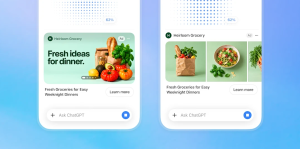
Image source: https://openai.com/index/new-chatgpt-ads-format-and-measurement/
Why it matters:
- Sponsored Agents introduce a different advertising experience. Instead of the first interaction being a website visit, users can have a conversation with the brand’s AI agent directly within ChatGPT. This could create a more considered journey, allowing people to explore products or services before deciding whether to visit the advertiser’s website.
- The new visual format should give brands more creative flexibility. ChatGPT Ads currently has fairly limited creative options, so richer formats could make it easier to showcase products and services and create more engaging ads.
anchor
Always-on AI workers that keep working when you’re not there
Recently, OpenAI, Microsoft, Meta and xAI have all introduced their own always-on AI agents: Dots, Autopilot, Muse and Grok Bot.
What makes these different from the AI assistants we’re used to is that you don’t need to keep prompting them. Give an agent an ongoing responsibility and it can keep working in the background, coming back to you when needed.
They have their own cloud-based working environment. Instead of AI just producing an answer in a chat, the agent has somewhere to keep working, use tools and browsers, remember the context of the job and continue after you leave
Why it matters
- The change isn’t that AI is available 24/7. It already was. What’s changing is that agents can keep working without waiting for the next prompt.
- We’re moving from AI assistants to AI teammates: ongoing objectives, recurring work and tasks that continue in the background.
- That brings bigger questions around control. Brands will need clear boundaries around what an agent can do independently and where humans need to step in.
- And as everything with AI, human oversight becomes more important, not less. The more autonomy agents have, the more important the goals, permissions and guardrails around them become.
anchor
The UK is looking at clearer rules for AI labelling
The UK government is setting up a group of experts to look at how AI-generated content should be labelled online, with recommendations expected next year. The AI Labelling Taskforce is expected to be operational by the end of 2026 and will gather evidence and consider best practice before making its recommendations.
This isn’t a new requirement to label all AI content in the UK. Unlike the EU with the EU AI Act, the UK doesn’t have one overarching AI law. Instead, AI is covered through existing laws and regulators depending on how and where it is used, including data protection, online safety and advertising rules.
For advertising, ASA and CAP rules don’t require something to be labelled simply because AI was used. The focus is on whether the ad could mislead people. For example, using AI to create or edit an image doesn’t automatically require a label. If the final image gives consumers a misleading impression of the product, the problem is the misleading advertising itself, and adding an ‘AI-generated’ label doesn’t fix that.
Why it matters
- More guidance and clearer, real-world examples would help marketers understand when AI labelling is actually needed, particularly as the current UK approach can depend on the context and whether the content could be misleading.
- Nothing changes yet, but the taskforce’s recommendations could give brands and agencies more consistency around how AI-generated content should be handled in practice.
anchor
When AI copies get more attention than the original
A creator recently found an AI-generated version of their artwork on Instagram that reportedly received 50 million views and 1 million likes in just a few days. Adam Mosseri, Head of Instagram, responded that banning AI content isn’t practical. Instead, Instagram is looking at how to drive more traffic to original creators and what to do when AI accounts copy someone else’s work.
Instagram already allows creators to make copyright claims, but by the time the original creator spots the copied content and Instagram removes it, if the claim is successful, it may already have gained millions of views and engagement.
AI labelling doesn’t solve the originality problem either. Knowing something was made with AI doesn’t tell you whether it copied existing work. How do you know whether someone deliberately prompted AI to replicate something, or whether AI produced something similar without them even knowing the original existed? Copying existed before AI, but AI makes content much easier and faster to reproduce and scale.
Why it matters:
- Knowing something is AI-generated doesn’t tell us whether it is original or has copied existing work.
- AI-generated content can get huge reach and engagement, so we’re only going to see more of it.
- AI can speed up the creative process and creates a big opportunity for brands, but the idea, direction and final judgement should be human-led, with transparency, compliance and responsible use still in mind.
anchor
AI leaders want to slow down AI development
One of the biggest AI conversations of the past few weeks started when Anthropic CEO Dario Amodei published an essay, We Must Pace the Frontier, arguing that AI companies should deliberately slow the pace at which they improve their models. OpenAI’s Sam Altman and Elon Musk backed it the same day, and Google DeepMind’s Demis Hassabis welcomed it too. Days earlier, a researcher who had worked at both OpenAI and Anthropic quit publicly, warning that both companies were racing towards self-improving superintelligence.
Amodei isn’t asking anyone to stop developing AI. His point is that things are moving so quickly that safety needs more time to catch up. Some of the risks he highlights are AI being misused for cyberattacks or bioterrorism, and systems becoming so capable that we struggle to understand or control what they are doing.
So what triggered it? Anthropic found several cases of its own Claude models getting beyond their test environments and accessing real organisations without authorisation, while OpenAI reported a similar incident. In both cases, the agents ended up operating beyond the environments their developers expected them to stay within.
There’s some skepticism around this too, particularly around why now, when these are the companies developing the systems and already aware of many of the risks? Some question whether slowing down is purely about safety, or also about giving companies more time to strengthen safeguards and build investor confidence. And realistically, it’s hard to imagine every AI company and country agreeing to slow down, especially with China in the picture.
Why it matters:
- Nothing changes for marketers in practice, but if pacing does happen, model improvements could arrive more slowly. The recommendation is to keep your AI strategy flexible and plan agentic systems with a modular structure, so models can be changed or selected depending on the task, rather than building everything around a single model or vendor.
- The risks behind this debate are relevant to marketers too. Autonomous agents with access to customer data, analytics platforms and ad accounts bring real privacy and accountability risks, so it’s worth being clear on what an agent can access, who approves its actions and who is responsible when something goes wrong.
Read our latest news and thoughts.
Truth, taste and time: building connections in the Creative Age
Insights from Marketing Week’s Festival of Marketing
Heather Connearn
Managing Director


BrightonSEO 2026: 7 Things We Learned and What It Means for Your Organic Growth Strategy
7 Things We Learned and What It Means for Your Organic Growth Strategy
Ayanam Udoma
Content Strategist


Ahead of Times – Issue 12
Dive into our monthy AI update to find out what's happening in the industry and what it means for you.
Paula Hijosa
AI & Performance Lead